Roman Numerals and Scale Degrees
Roman numerals describe the relationship between chords and the tonal center. Once you can read them, the same progression makes sense in every key.
Roman numerals can look more complicated than chord names at first, but they solve a very practical problem.
A progression such as:
C – G – Am – F
only tells us what to play in one key.
The pattern behind it is more general. Roman numerals let us describe that pattern without tying it to C major.
Before we get to the numerals themselves, we need one simple idea: scale degrees.
Scale degrees number the positions in a scale
Take the C major scale:
C D E F G A B
We can number those notes from 1 to 7:
| Scale degree | Note in C major |
|---|---|
| 1 | C |
| 2 | D |
| 3 | E |
| 4 | F |
| 5 | G |
| 6 | A |
| 7 | B |
The numbers describe positions relative to the key.
If we change to G major, the notes change:
G A B C D E F#
but the degree numbers stay the same:
| Scale degree | Note in G major |
|---|---|
| 1 | G |
| 2 | A |
| 3 | B |
| 4 | C |
| 5 | D |
| 6 | E |
| 7 | F# |
Degree 1 is the tonal center: the note that feels like home.
That is the important idea. A scale degree describes a relationship, not one fixed note name.
Roman numerals describe chords built on those degrees
Now we can build chords on the scale degrees.
In C major, the basic three-note chords are:
| Degree | Chord | Roman numeral |
|---|---|---|
| 1 | C major | I |
| 2 | D minor | ii |
| 3 | E minor | iii |
| 4 | F major | IV |
| 5 | G major | V |
| 6 | A minor | vi |
| 7 | B diminished | vii° |
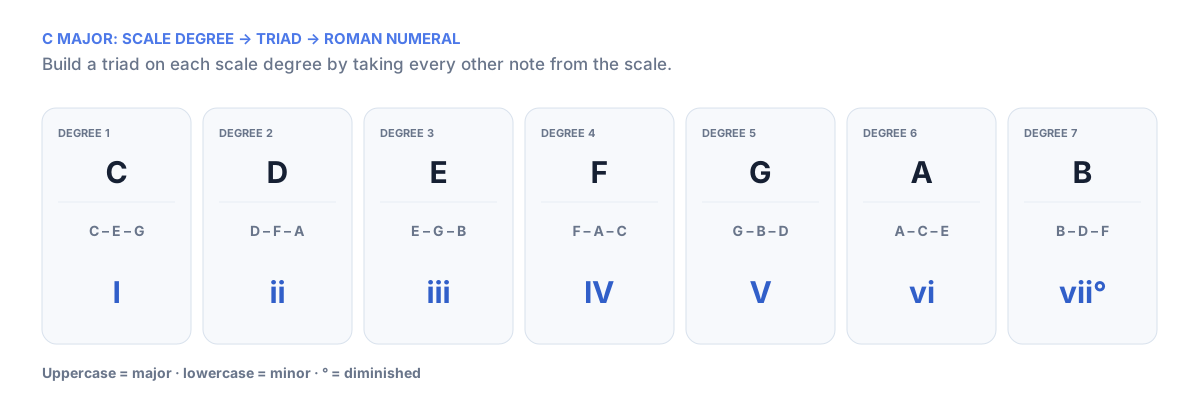
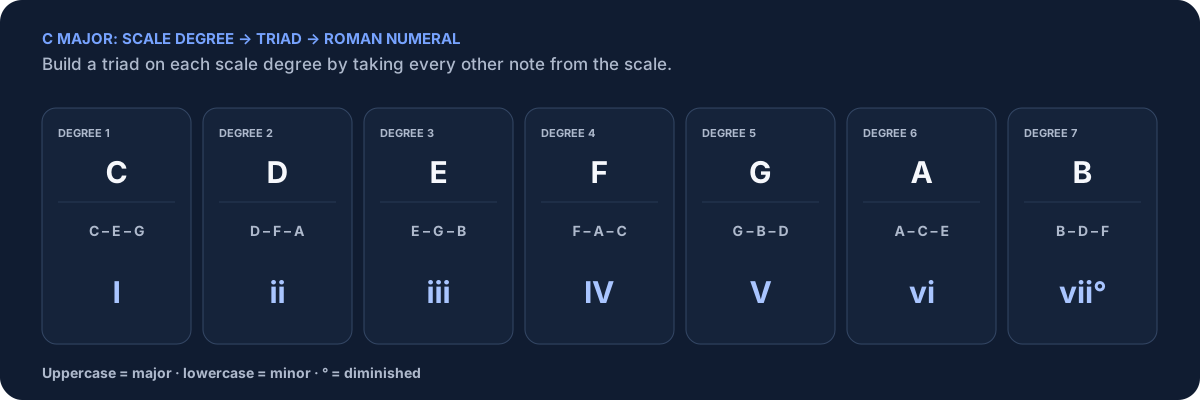
The Roman numeral tells us two useful things at once:
- where the chord is rooted in the key;
- what basic chord quality it has.
So IV means a major chord rooted on degree 4.
In C major that is F major.
In G major, degree 4 is C, so IV becomes C major.
The relationship stays the same even though the chord name changes.
Uppercase, lowercase and the diminished symbol
The case of the Roman numeral matters.
Uppercase normally means a major chord:
I IV V
Lowercase normally means a minor chord:
ii iii vi
A small degree symbol marks a diminished chord:
vii°
So these are not different ways of styling the same number. They contain information about the chord.
For example:
IImeans a major chord on degree 2;iimeans a minor chord on degree 2;ii°means a diminished chord on degree 2.
That difference becomes important as soon as music moves outside the simplest major-scale chords.
Why Roman numerals are useful
Consider this progression in C major:
C – G – Am – F
Its Roman-numeral pattern is:
I – V – vi – IV
Now move the same pattern to G major.
The chords become:
G – D – Em – C
but the Roman numerals are still:
I – V – vi – IV
Move it to D major:
D – A – Bm – G
and the pattern is still:
I – V – vi – IV
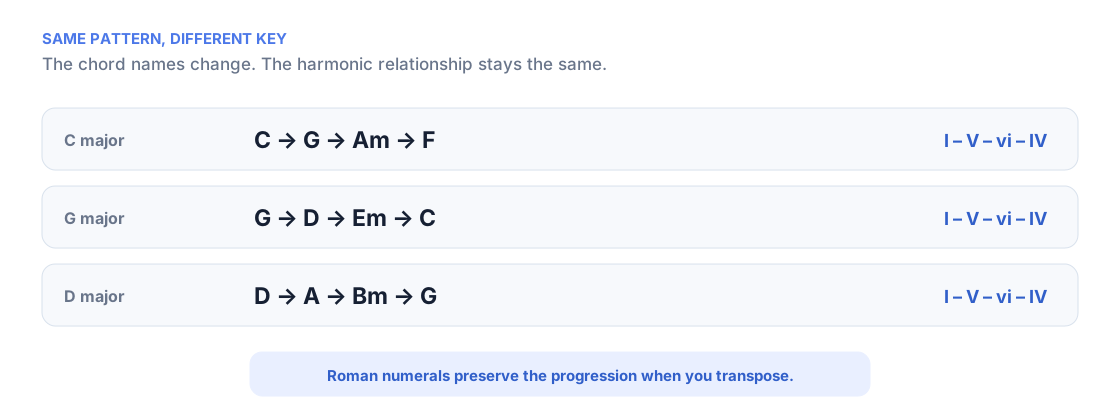
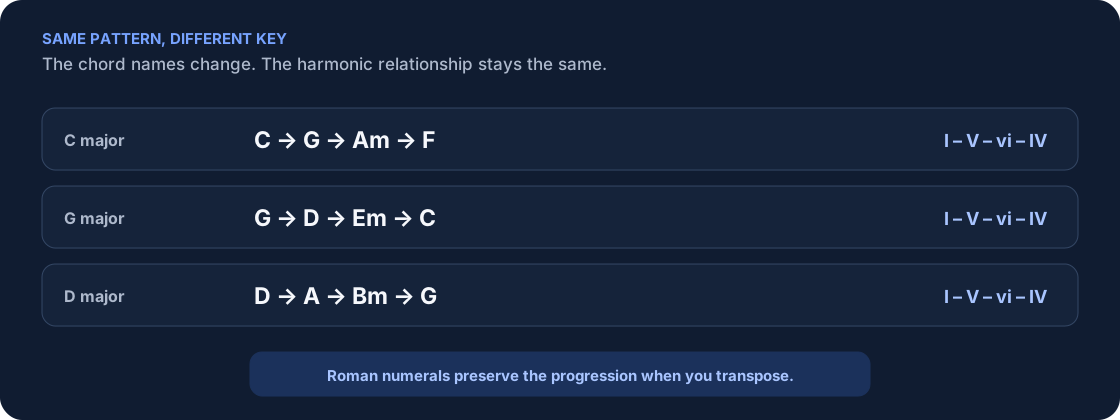
This is why Roman numerals are so useful in a chord progression tool.
The useful musical idea is often not “C, G, Am, F”.
The useful idea is:
I – V – vi – IV
The key decides which chord names realize that pattern.
Flats and sharps before a Roman numeral
You will also see accidentals before Roman numerals, such as:
♭III
♭VI
♭VII
Chord Progression Studio uses a major-reference coordinate system for these labels.
Start with A major:
A B C# D E F# G#
Its degrees are:
1 2 3 4 5 6 7
Now compare A natural minor:
A B C D E F G
The 3rd, 6th and 7th degrees are one half step lower than in A major.
So we can describe the A natural-minor scale as:
1 2 ♭3 4 5 ♭6 ♭7
The same idea carries into the chord labels.
The basic chords in A natural minor are:
| Degree | Chord | Roman numeral |
|---|---|---|
| 1 | A minor | i |
| 2 | B diminished | ii° |
| ♭3 | C major | ♭III |
| 4 | D minor | iv |
| 5 | E minor | v |
| ♭6 | F major | ♭VI |
| ♭7 | G major | ♭VII |
That is why a familiar A-minor progression:
Am – F – C – G
is shown in the Studio as:
i – ♭VI – ♭III – ♭VII
The flat sign belongs to the root degree. The uppercase numeral still tells us that the chord itself is major.
So ♭VI means:
- take degree 6;
- lower its root by one half step compared with the major reference;
- build a major chord there.
It does not mean “make the whole chord flat”.
You may see a different minor-key convention elsewhere
Music theory notation is not perfectly universal.
Some books and websites write the same natural-minor chords as:
i ii° III iv v VI VII
In that convention, the degree numbers are treated as positions inside the minor scale itself, so the flats are left out.
Other systems, including Chord Progression Studio, keep the major scale as the reference and write:
i ii° ♭III iv v ♭VI ♭VII
Both conventions are trying to describe the same harmony.
We use the second form because the accidentals make the altered scale degrees explicit and keep the same coordinate system when comparing Major, Minor, Dorian, Mixolydian and other scales.
The important thing is consistency.
Reading a progression step by step
Suppose you see:
i – ♭VI – ♭III – ♭VII
You can read it one chord at a time.
i
Degree 1, minor chord.
In A minor: Am.
♭VI
Lowered degree 6, major chord.
In A: F.
♭III
Lowered degree 3, major chord.
In A: C.
♭VII
Lowered degree 7, major chord.
In A: G.
So:
i – ♭VI – ♭III – ♭VII
becomes:
Am – F – C – G
Change the key to D minor and the same Roman-numeral progression becomes:
Dm – Bb – F – C
Again, the chord names change while the pattern survives.
Extra symbols can add more information
Roman-numeral notation can carry more information than the basic examples above.
You may later see labels such as:
V7
or Roman numerals that include inversion or other chord information.
You do not need to decode all of those yet.
For now, read the numeral in layers:
- accidental, if there is one;
- scale degree;
- uppercase or lowercase chord quality;
- any extra chord information after that.
Later chapters on chord extensions and inversions will explain those extra details.
Roman numerals do not describe the whole sound
Two producers can use exactly the same Roman-numeral progression and end up with completely different music.
Roman numerals do not tell you:
- which octave to play;
- how widely to spread the notes;
- which inversion to use;
- how long each chord lasts;
- what rhythm to play;
- which instrument or synth patch to use.
They describe the underlying harmonic relationship.
That is exactly why they are useful: they separate the progression idea from the way that idea is arranged and produced.
Once that notation is familiar, the scale and progression chapters that follow become much easier to read.