Jazz Chord Progressions
Jazz harmony often treats chord color and voice leading as structural. The same functions can appear in simple seventh chords, richer extensions or modal vamps.
Jazz harmony covers an enormous range of music.
There is no single “jazz chord progression” any more than there is one jazz rhythm or one jazz sound.
Some jazz is strongly functional, with chords creating clear tension and resolution.
Some is modal, staying on one harmony or moving between only a few chords for a long time.
Some leans heavily on blues.
Some uses chromatic substitutions and extended chords that move very quickly.
So this guide focuses on a few reusable harmonic ideas rather than trying to define the entire genre.
Seventh chords are often structural, not decoration
In many pop or electronic contexts, a seventh can be an optional color added to a triad.
In jazz, seventh chords are often the basic harmonic unit.
Compare:
Dm – G – C
with:
Dm7 – G7 – Cmaj7
Both describe similar root movement:
ii – V – I
but the seventh chords carry much more information.
The extra notes help define function and create smoother voice leading between chords.
That is why removing the sevenths from a jazz progression can change more than the color. It can weaken the harmonic identity itself.
The ii-V-I is a central functional pattern
One of the most important jazz progressions in a major key is:
ii7 – V7 – Imaj7
In C major:
Dm7 – G7 – Cmaj7
The chords are:
Dm7 = D – F – A – C
G7 = G – B – D – F
Cmaj7 = C – E – G – B
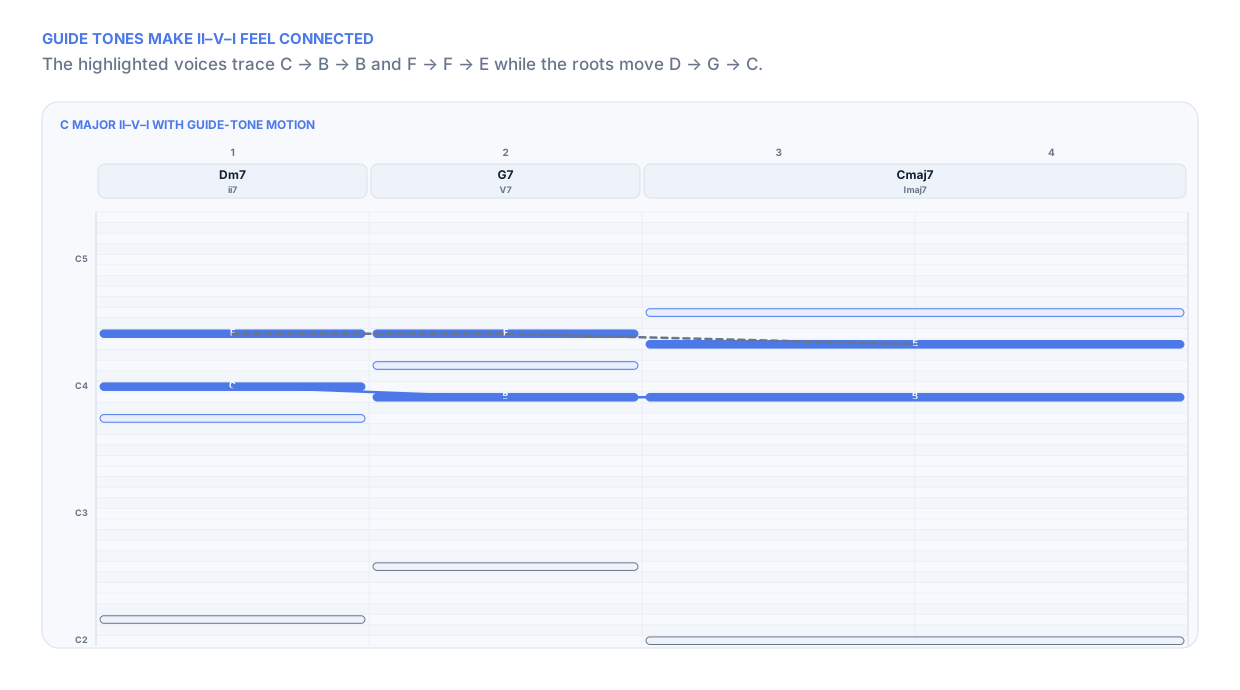
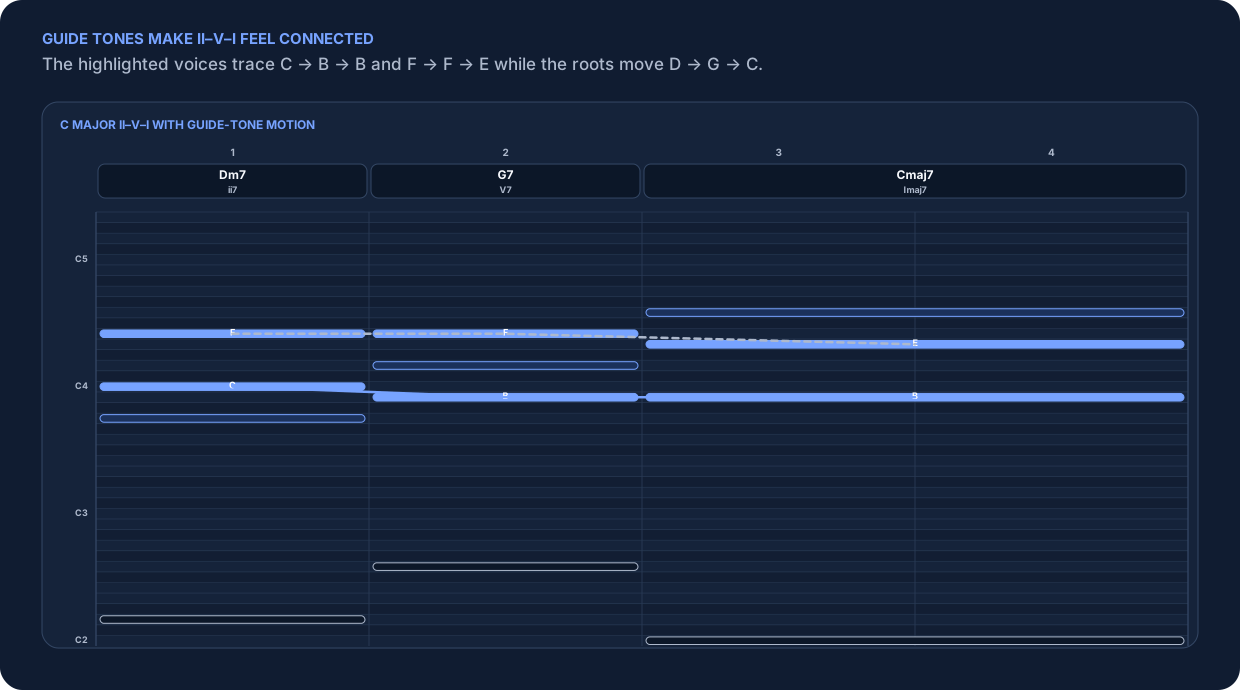
The root movement is important, but the internal voices are just as important.
Notice the guide tones:
- F is the 3rd of Dm7 and the 7th of G7;
- B is the 3rd of G7 and becomes the major 7th of Cmaj7;
- F can move down by a half step to E when G7 resolves to Cmaj7.
Those small movements make the progression feel connected.
Guide tones matter more than playing every note
The 3rd and 7th often tell the listener what a seventh chord is doing.
For G7:
G – B – D – F
B is the major 3rd.
F is the minor 7th.
Those two notes contain much of the dominant character.
If a bassist is already playing G, a pianist or guitarist may not need to place another G at the bottom of the voicing.
That opens space for the guide tones and extensions.
This is one reason jazz voicings can look very different from root-position block chords while still sounding harmonically clear.
The tonic can be allowed to settle
A ii-V-I does not need equal chord lengths.
A useful long form is:
Dm7 | G7 | Cmaj7 |
where ii and V each last one bar and I lasts two bars.
That gives the resolution more space.
The Studio preserves forms like this instead of automatically forcing every harmonic event to the same duration.
Timing is part of the phrase.
Extensions can enrich the same function
The same ii-V-I family can be colored more richly:
Dm9 – G13 – Cmaj9
The functions have not fundamentally changed.
Dm9 is still ii.
G13 is still V.
Cmaj9 is still I.
But the upper notes create a different texture.
That does not mean every jazz chord needs as many extensions as possible.
A good extension should be audible and useful.
If every chord contains 9ths, 11ths and 13ths in a dense low register, the result can become muddy rather than sophisticated.
Voice leading comes before chord-name complexity
A progression with simple seventh chords and good voice leading can sound more convincing than a progression full of extensions that jump awkwardly.
For example:
Dm7 → G7 → Cmaj7
already contains several smooth possibilities.
The notes do not need to leap to entirely new positions every time the chord symbol changes.
A practical jazz voicing often tries to:
- retain common tones;
- move guide tones by small intervals;
- keep the register comfortable;
- avoid unnecessary doubling;
- leave space for bass and melody.
The chord symbol tells you what harmony is required.
The voicing decides how that harmony actually lives in the arrangement.
The 1-6-2-5 turnaround
Another common major-key pattern is:
Imaj7 – vi7 – ii7 – V7
In C major:
Cmaj7 – Am7 – Dm7 – G7
This is often called a 1-6-2-5 turnaround.
It creates a circular sense of motion that naturally wants to return to I.
The roots move through a chain of descending fifths:
C → A → D → G → C
That kind of movement is very common in functional jazz harmony.
A secondary dominant can strengthen the turnaround
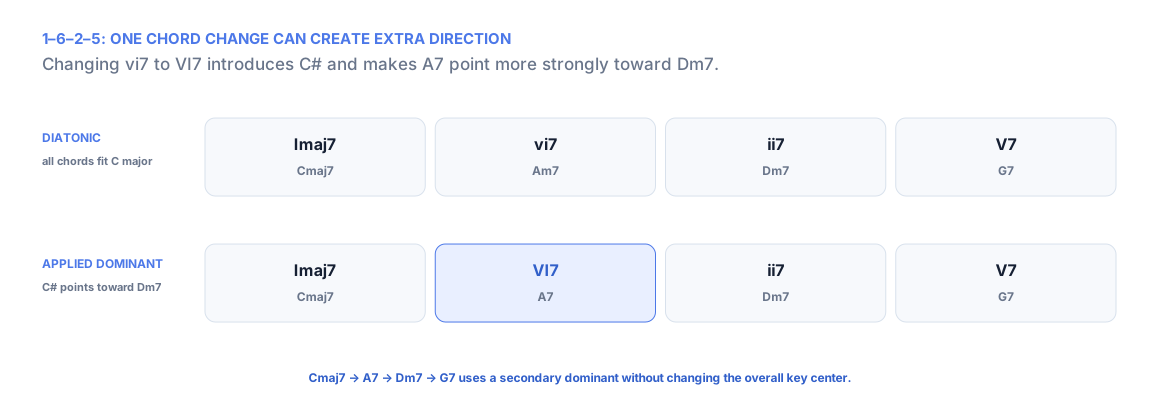
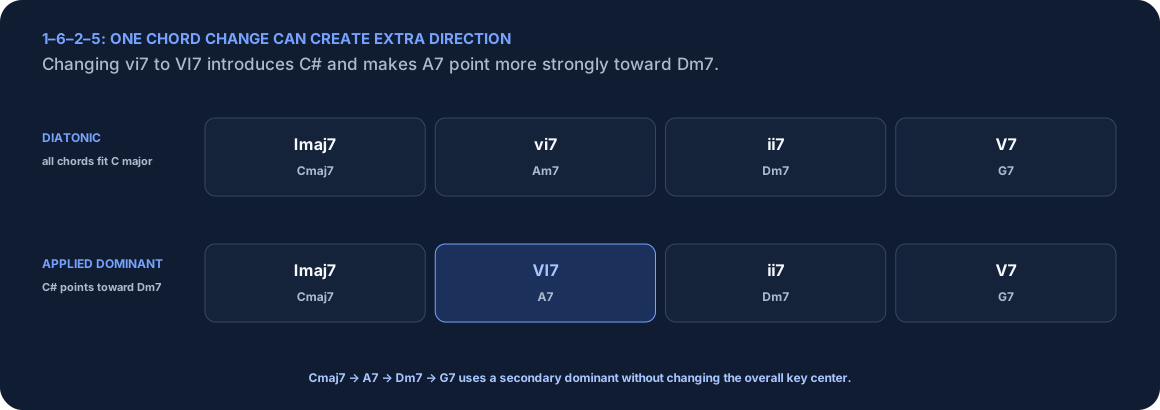
The vi chord in a 1-6-2-5 can be changed from minor to dominant:
Imaj7 – VI7 – ii7 – V7
In C:
Cmaj7 – A7 – Dm7 – G7
A7 contains C#, which is outside C major.
Why use it?
Because A7 strongly points toward Dm7.
In other words, A7 temporarily behaves like the dominant of ii.
This is a secondary dominant.
The progression remains centered in C major, but one chromatic note creates a stronger local pull.
Jazz uses this kind of temporary tension constantly.
Chromatic chords do not always mean a key change
Seeing an outside chord does not automatically mean the music has modulated to a new key.
A chromatic chord may exist for only a moment to:
- approach the next chord;
- strengthen a dominant relationship;
- create smoother bass movement;
- preserve guide-tone motion;
- provide a substitution.
This is why jazz harmony often makes more sense when you ask:
Where is this chord going?
rather than only:
Which scale contains all of its notes?
Function and voice leading can explain a chord that one static scale cannot.
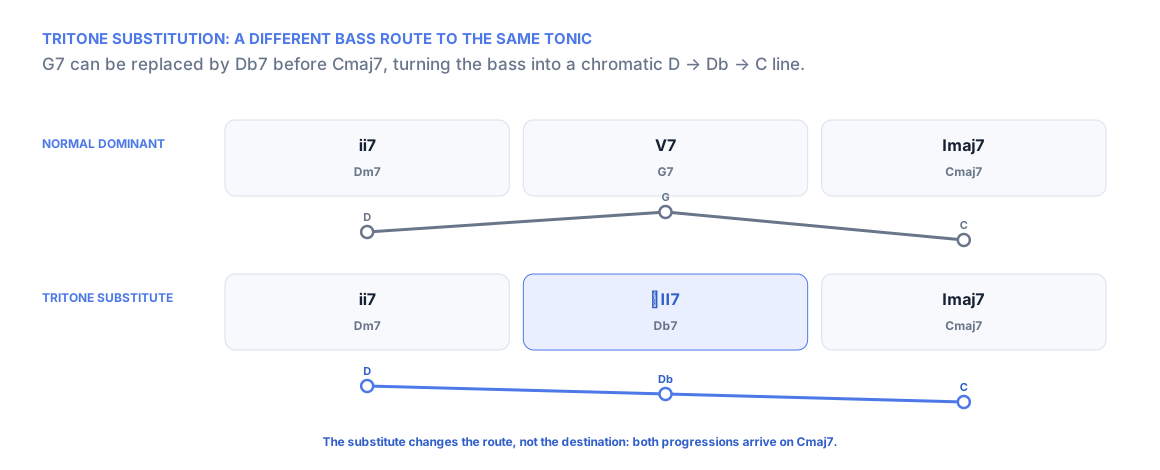
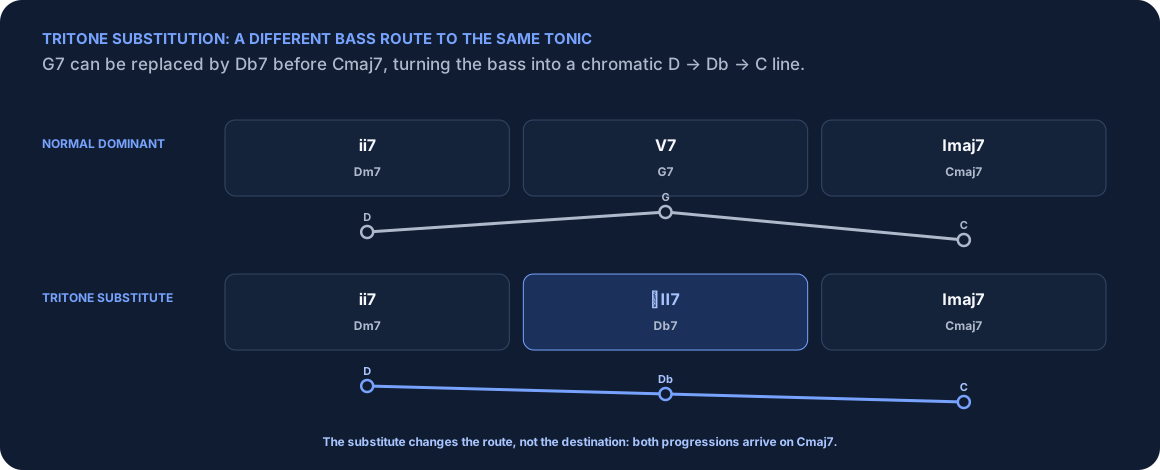
Tritone substitution changes the dominant route
A dominant seventh contains an important interval between its 3rd and 7th: the tritone.
Two dominant chords whose roots are a tritone apart can share the same guide-tone pitch classes in reversed roles.
That creates one of the best-known jazz substitutions.
Instead of:
Dm7 – G7 – Cmaj7
we can use:
Dm7 – Db7 – Cmaj7
Db7 substitutes for G7.
The bass movement becomes chromatic:
D → Db → C
while the dominant tension still resolves toward C.
This is a powerful example of how jazz can change the bass route while preserving a similar harmonic purpose.
The backdoor cadence approaches I from another direction
Another major-key alternative in the Studio is:
iv7 – ♭VII7 – Imaj7
In C major:
Fm7 – Bb7 – Cmaj7
This is often called a backdoor cadence.
Instead of using G7 to approach C, the harmony moves through borrowed minor-subdominant and flat-seven dominant color.
The result can sound warm and smooth while still creating a convincing arrival on I.
Again, the lesson is not that one cadence should replace another.
Jazz offers several routes to the same destination.
Modal jazz can reduce harmonic movement dramatically
Jazz is not always about fast functional changes.
A modal vamp may stay on one chord for a long time.
A Dorian example is:
i7 – IV7
In D Dorian:
Dm7 – G7
The G7 chord contains B natural, the characteristic natural 6 of D Dorian.
The same Roman-numeral pattern also appears in house and blues contexts.
What changes is the realization.
In jazz, the harmony may be voiced more openly, played with different rhythmic comping and used as a stable environment for melodic improvisation.
The progression itself does not own the genre.
Quartal voicing can change the texture without changing the tonal center
Jazz voicings are not limited to stacks of thirds.
Notes can also be arranged in fourths.
For example, a D-Dorian context can use wide quartal structures that emphasize the mode without spelling a conventional close-position chord from bottom to top.
That can create a more open, ambiguous sound.
The important distinction is that voicing and harmonic identity are related but not identical.
A chord can retain its role while the spacing of its notes changes radically.
Mixolydian can support dominant-centered modal harmony
A Mixolydian jazz vamp may center on a dominant chord rather than treating that chord as something that must resolve immediately.
For example, a tonic dominant color can include:
1 – 3 – 5 – ♭7 – 9 – 13
That might produce a chord such as:
C13
with additional upper color.
In this context, C7 or C13 can function as the tonal center rather than as V of F.
This is another reminder that a chord symbol does not have one universal function independent of context.
Minor ii-V-i uses a different ii chord
In a minor key, the ii chord often becomes half-diminished.
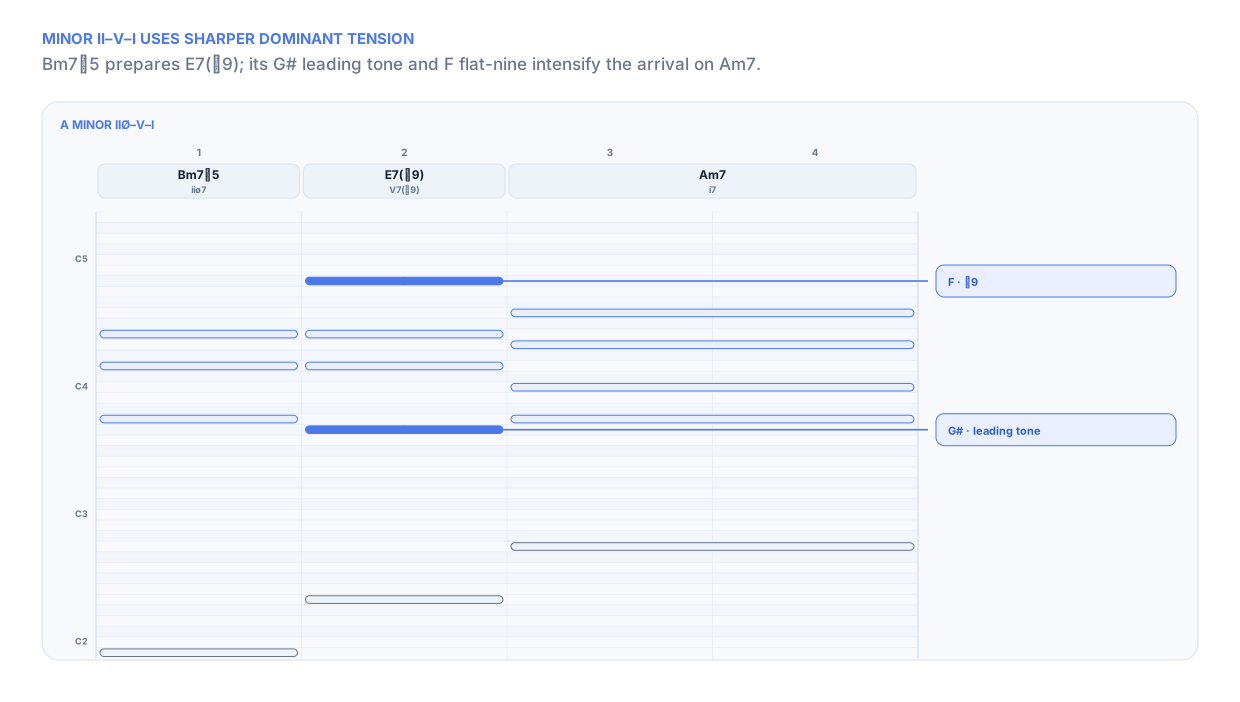
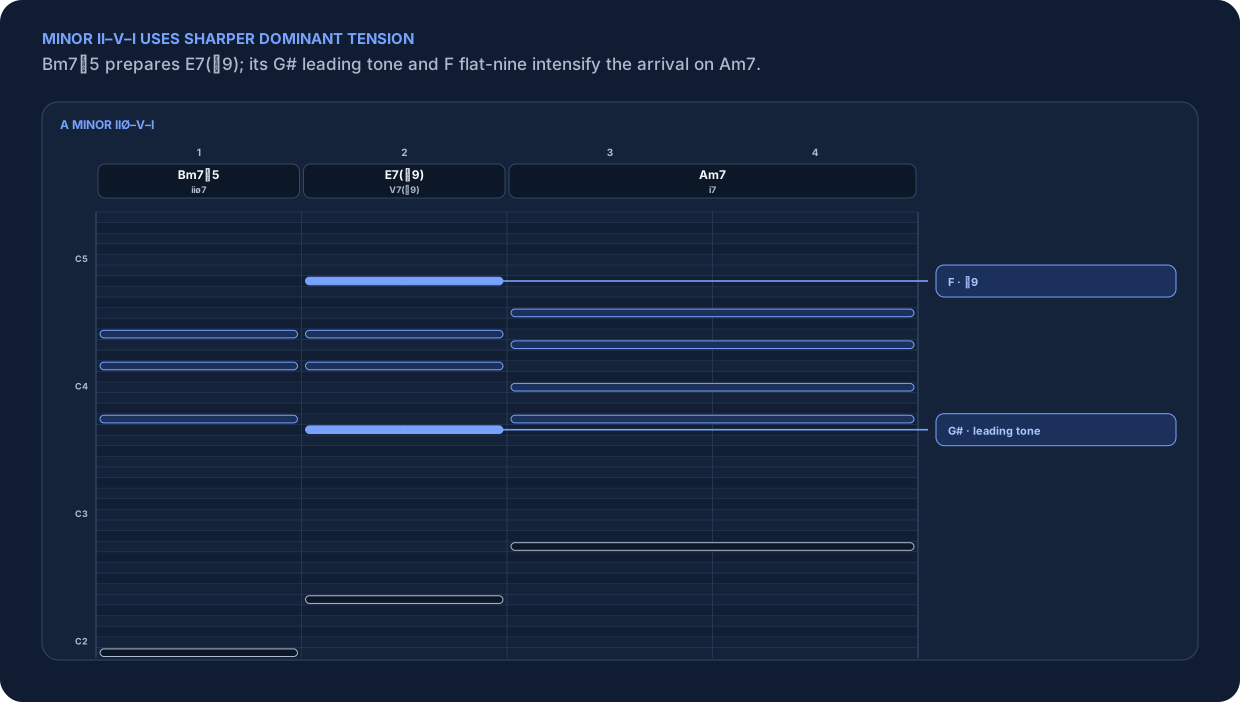
A useful minor cadence in A is:
iiø7 – V7(b9) – i7
which becomes:
Bm7♭5 – E7(b9) – Am7
The iiø7 prepares the dominant.
E7(b9) contains strong tension, including the raised leading tone G#.
Am7 provides the minor tonic arrival.
This is a very different color from the major-key:
Dm7 – G7 – Cmaj7
but the larger functional idea is related:
preparation → dominant → tonic.
Minor harmony often mixes natural and harmonic minor behavior
The V7 in a minor ii-V-i normally needs a raised 7th.
In A minor:
E7 = E – G# – B – D
G# does not belong to A natural minor.
That is not a problem.
The raised leading tone gives the dominant its strong pull toward A.
Jazz minor harmony often uses whatever form of the minor scale best supports the current harmonic function.
Trying to force the whole progression into one unchanging seven-note collection can make the theory harder rather than clearer.
Jazz and blues overlap, but they are not the same harmonic language
Jazz uses many blues forms and colors.
Blues also contains dominant sevenths, chromatic notes and voice-leading ideas that jazz players build on.
But a 12-bar blues form and a ii-V-I are not interchangeable concepts.
The Studio keeps full blues forms intact rather than reducing them into generic jazz cadences.
Likewise, modal and functional jazz forms retain their own structure.
Genre labels overlap because music overlaps, but preserving the actual form is more useful than forcing every example into one category.
Do not add extensions just because the style says Jazz
A common caricature of jazz harmony is:
Take a chord and keep adding numbers.
That misses the point.
Extensions should have a musical role.
A 9th can soften or widen a voicing.
A 13th can add color to a dominant.
A ♭9 can intensify a minor-key V7.
A #11 can create a distinctive major or dominant color.
But if those notes are not voiced clearly, they may only create clutter.
Jazz harmony is often sophisticated because of relationships and voice leading, not because the chord symbol is long.
Rootless voicing depends on context
In an ensemble, the bass player may already make the root unmistakable.
That allows a pianist or guitarist to omit the root and focus on:
- 3rd;
- 7th;
- extensions;
- smooth inner movement.
In a standalone chord-progression preview, however, removing every root can make the harmony harder to hear.
That is why context matters.
A rootless voicing can be ideal in an arrangement and confusing in isolation.
The Studio can provide tonic support while still favoring the guide-tone logic that makes jazz voicing useful.
A practical Jazz starting point in the Studio
If you want to explore jazz harmony:
- choose Jazz as the style;
- try Major / Ionian for ii-V-I and turnaround harmony;
- try Dorian for modal minor vamps;
- try Mixolydian for dominant-centered modal color;
- try Minor / Aeolian or Harmonic Minor for minor ii-V-i movement;
- listen to the 3rds and 7ths as chords change;
- compare plain seventh-chord versions with richer extensions;
- notice when chromatic chords create direction rather than a permanent key change.
Most importantly, do not treat the Roman numerals as a complete performance.
In jazz, the progression gives you the harmonic route.
The voice leading, voicing, rhythm, bass and melodic response determine how that route is travelled.