Blues Chord Progressions
Blues harmony has recognizable forms, but those forms are frameworks rather than fixed scripts. Timing, dominant-seventh color and turnaround choices strongly affect the result.
Blues harmony is simple enough to recognize quickly and deep enough to keep changing for a lifetime.
The famous I–IV–V relationship is a good starting point, but it is not the whole language.
What makes blues harmony distinctive is the combination of:
- repeated formal patterns;
- dominant-seventh chord color;
- tension that does not always behave like classical functional harmony;
- strong interaction between chords, melody and bass;
- rhythmic feel;
- turnarounds and substitutions.
A 12-bar form is therefore best understood as a framework, not as one fixed progression that every blues track must use.
The three main chords: I, IV and V
In a simple major-key framework, the three most important roots are:
I
IV
V
In C, those roots are:
C – F – G
If we were writing ordinary diatonic C-major harmony, we might expect:
C – F – G
or:
I – IV – V
Blues often does something different.
The chords are frequently dominant sevenths:
C7 – F7 – G7
or:
I7 – IV7 – V7
That small “7” is a big part of the sound.
Why I7 is unusual
In conventional major-key harmony, a dominant seventh normally belongs on V.
In C major:
G7 = G – B – D – F
That chord strongly points toward C.
But blues commonly uses:
C7 = C – E – G – Bb
on the tonic itself.
So I7 is simultaneously home and harmonically colored with a lowered seventh.
The same happens with IV7:
F7 = F – A – C – Eb
Those notes do not all belong to one plain C-major scale.
That is one reason blues should not be reduced to “pick one scale and only use its notes”.
Blues harmony mixes chord color, melodic language and tonal center in its own way.
Mixolydian is a useful reference, not the whole explanation
Mixolydian contains a major third and a flat seventh:
1 2 3 4 5 6 ♭7
That makes it a useful reference for a tonic dominant-seventh chord.
For C7:
C – E – G – Bb
C Mixolydian contains all four chord tones.
But if the progression moves to F7, the Eb in F7 does not belong to C Mixolydian.
Then G7 introduces B natural again.
So a whole blues chorus is not necessarily “in one Mixolydian scale” in the simple sense.
It is more useful to think of Mixolydian as an important part of the vocabulary while allowing each dominant chord to bring its own color.
The basic 12-bar blues form
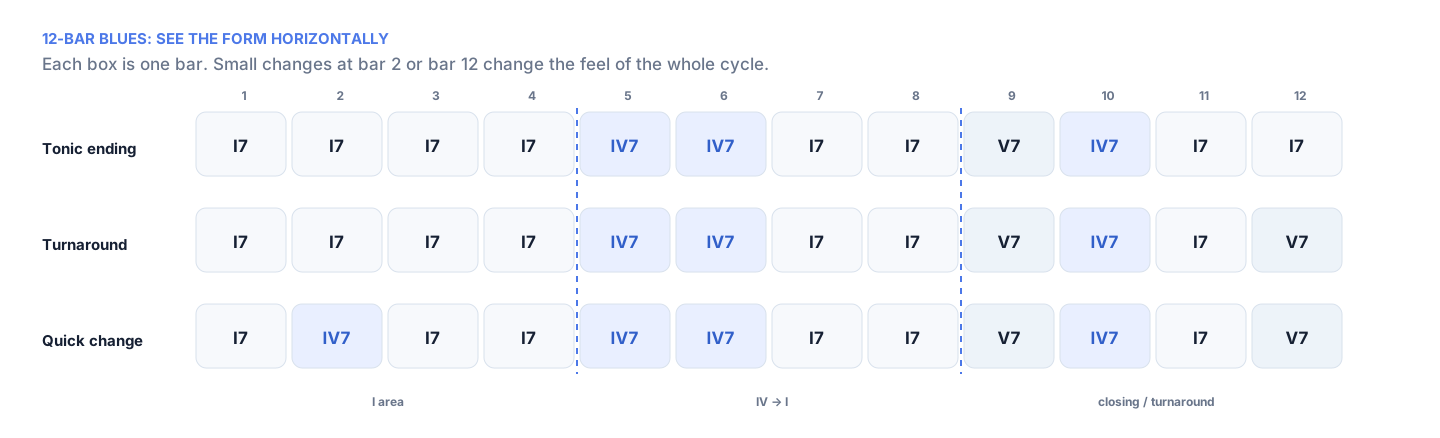
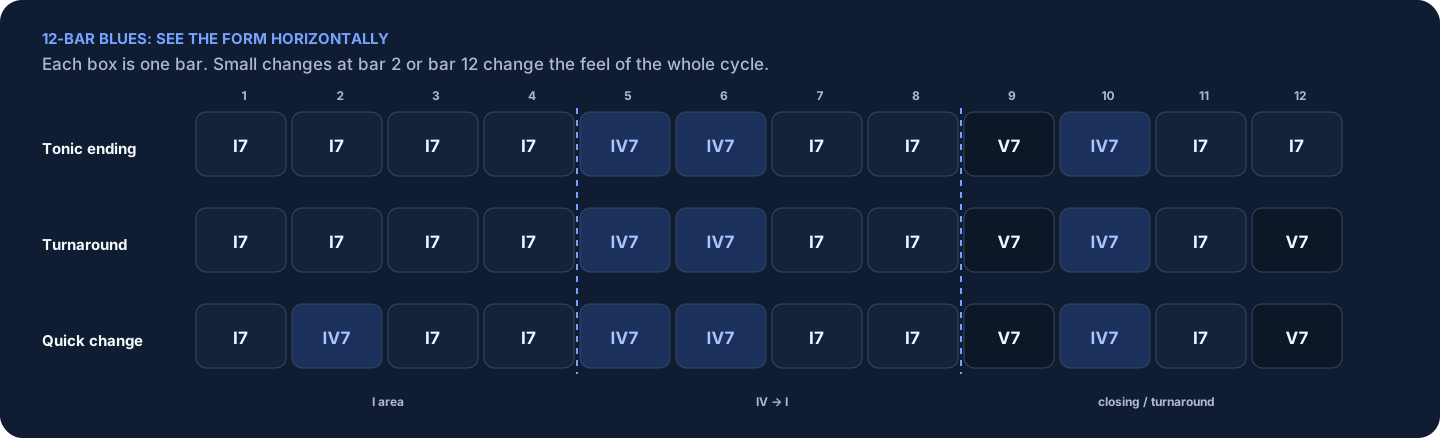
One common 12-bar structure spends four bars on I7, moves to IV7 for bars 5 and 6, returns to I7, then closes with V7–IV7–I7. The first row below shows that form with a tonic ending.
In C:
C7 | C7 | C7 | C7 |
F7 | F7 | C7 | C7 |
G7 | F7 | C7 | C7 |
This version settles on the tonic for the final two bars.
The form is easy to remember because it moves in three large stages:
- establish I;
- move to IV and return;
- create a V–IV–I closing gesture.
But even this “basic” version is only one choice.
A turnaround changes the final bar
Instead of ending with I7 in bar 12, many blues forms use V7. That is the difference shown in the second row of the diagram above.
That final V7 is a turnaround.
It does not finish the harmony.
It points back toward the I7 at the beginning of the next chorus.
So the listener hears:
... I7 → V7 → I7 ...
across the repeat boundary.
This is very similar to the open-loop idea we discussed in other genres: the last chord only makes full sense when you hear what comes next.
The quick change
Another common variation changes bar 2 from I7 to IV7. The third row of the diagram shows this early move to IV7 while keeping the larger 12-bar framework intact.
This is often called a quick change.
The harmony briefly visits IV much earlier than in the slow-change version.
The rest of the form may remain almost identical.
That single bar changes the sense of motion without requiring a completely different 12-bar structure.
This is a good example of how blues variation often works: a familiar framework remains recognizable while one or two strategic bars change.
Repeated bars are real musical structure
When a 12-bar form contains four bars of I7, it is tempting to compress that mentally into:
“just one I7 chord”.
But the duration matters.
Four bars of I7 create a different form from one bar of I7 followed immediately by IV7.
Those repeated bars give space for:
- vocal phrases;
- riffs;
- fills;
- call and response;
- bass movement;
- comping variation.
So in the Studio, repeated chord events in a blues form are preserved rather than automatically collapsed.
The chord label may stay the same while the phrase continues to develop.
Rhythm and harmonic rhythm are different things
Blues is strongly associated with rhythmic feel, but the groove does not determine how often the harmony changes.
A chord may remain I7 for an entire bar while the guitarist or pianist plays several rhythmic attacks inside that bar.
A shuffle, straight-eighth groove, slow blues or funkier blues feel can all use similar harmonic forms.
The performance rhythm tells us how the chord is played.
The harmonic rhythm tells us when the underlying harmony actually changes.
Keeping those ideas separate makes blues forms much easier to understand.
Dominant sevenths create guide-tone movement
The third and seventh of a dominant chord are especially important.
For C7:
C – E – G – Bb
the characteristic inner notes are E and Bb.
For F7:
F – A – C – Eb
the important color notes include A and Eb.
A good comping voicing does not need to move every note dramatically between chords.
Small movements between thirds and sevenths can make the progression feel connected.
This is one reason compact seventh-chord voicings work so well in blues, jazz and related styles.
The root may be reinforced by the bass while the chord instrument focuses more on the tones that define the chord quality.
Blues does not always need extra extensions
Because dominant sevenths are so characteristic, it is easy to assume that more extensions must always sound “more blues”.
They do not.
A plain:
C7
may be exactly right.
A ninth:
C9
can add color.
A thirteenth can add even more.
But those extensions change the voicing and density.
The Studio therefore treats them as specific harmonic choices rather than automatically decorating every blues chord.
A good blues progression can be harmonically rich while still using very simple chord symbols.
An applied dominant can add extra drive
The Studio also includes 12-bar variations that use an applied dominant before V.
For example, a bar may use:
II7 → V7
In C:
D7 → G7
D7 contains F#, which is outside the basic C-major or C-Mixolydian collection.
Its job is not to establish a new permanent key.
It temporarily increases the pull toward G7.
This kind of move shows how blues and jazz vocabularies can overlap without becoming the same genre.
The form remains blues; the harmonic route becomes more colorful.
Minor blues changes the emotional center
Blues does not have to use a major tonic.
A minor blues may center on:
i7
and use:
iv7
along with a major dominant V7.
In A minor, that could involve:
Am7
Dm7
E7
The major V7 introduces G#, creating a stronger pull back to Am.
One minor-blues form in the Studio also uses:
♭VI7 → V7
near the end of the chorus.
That adds chromatic tension before the turnaround.
Again, there is no requirement that one fixed scale explain every chord.
The tonal center remains minor while the progression borrows the notes needed for the harmonic motion.
A softer minor blues can keep v minor
Not every minor blues needs the strong major V.
Natural minor gives:
v = Em
in A minor.
A progression using a minor v can sound softer and less strongly cadential than one using E7.
That can be useful when the harmony should remain more modal or less resolved.
The choice between:
v → i
and:
V7 → i
is therefore expressive, not simply correct versus incorrect.
Dorian can bring a major IV into minor-centered blues
Dorian offers another important blues color.
In A Dorian:
A B C D E F# G
the tonic is minor:
Am
but the IV chord is major:
D
or often:
D7
So a vamp such as:
i7 – IV7
can support both blues and jazz-influenced language.
The natural 6 distinguishes it from ordinary natural minor.
This is one reason minor blues vocabulary often overlaps with Dorian without every track being strictly modal from beginning to end.
Not every blues is 12 bars
The 12-bar form is important, but it should not become a cage.
The Studio also contains:
- eight-bar blues forms;
- Dorian vamps;
- minor-blues forms;
- longer forms with chromatic passing harmony;
- forms that end on I;
- forms that end on V and turn around.
Outside the Studio, blues traditions contain many more structures again.
So “blues progression” should not be treated as a synonym for “one exact 12-bar sequence”.
The 12-bar framework is a powerful reference point, not the definition of all blues harmony.
The melody can disagree with the chord in useful ways
Blues melody often creates expressive friction against the harmony.
A melody may use notes associated with the minor third over a major or dominant tonic.
Bent notes may sit between equal-tempered pitches.
The melodic language can therefore sound more ambiguous than the chord symbols suggest.
That tension is part of the style.
It also explains why analysing blues purely as “which scale contains every note?” can be misleading.
The harmony, melody and performance practice interact rather than fitting neatly into one theoretical box.
A practical Blues starting point in the Studio
If you want to explore blues harmony:
- choose Blues as the style;
- start with Mixolydian for dominant-seventh major-centered forms;
- compare a slow-change 12-bar form with a quick-change version;
- listen to the difference between a tonic ending and a V7 turnaround;
- try Dorian for minor-centered harmony with a major IV;
- try Minor / Aeolian for darker minor-blues forms;
- pay attention to the 12-bar timing, not only the list of unique chord names.
Most importantly, hear the form as a cycle.
The repetition is not empty space between chord changes.
It is where the riffs, voice, bass, groove and improvisation get room to speak.