Cadences and Harmonic Resolution
Cadences describe how harmony approaches a point of rest. Some sound final, some stay open, and others deliberately avoid the resolution your ear expects.
A cadence is a harmonic ending or stopping point.
That does not necessarily mean the song stops. A cadence can happen at the end of a verse, at the end of a phrase, before a drop, or even at the point where a loop turns back to its beginning.
A useful way to think about cadences is as punctuation for harmony.
Some feel like a full stop.
Some feel more like a comma.
Some set up an expectation and then deliberately avoid it.
Cadence names come from recurring patterns in tonal music, but they are descriptions rather than rules. Modern pop, house, trance, jazz and other styles often use them loosely, weaken them, delay them or avoid them entirely.
Resolution means arriving somewhere that feels stable
In the previous chapter we looked at harmonic movement and the idea that some chords create more tension than others.
A resolution happens when that tension moves toward something that feels more stable.
The clearest example in a major key is:
V → I
In C major:
G → C
The G chord contains notes that strongly suggest movement back toward C. When C arrives, the phrase can feel settled.
That does not mean every V → I sounds equally final. Rhythm, melody, bass, voicing and where the change occurs in the phrase all affect how strong the resolution feels.
The chord movement gives us the harmonic tendency; the arrangement determines how strongly we hear it.
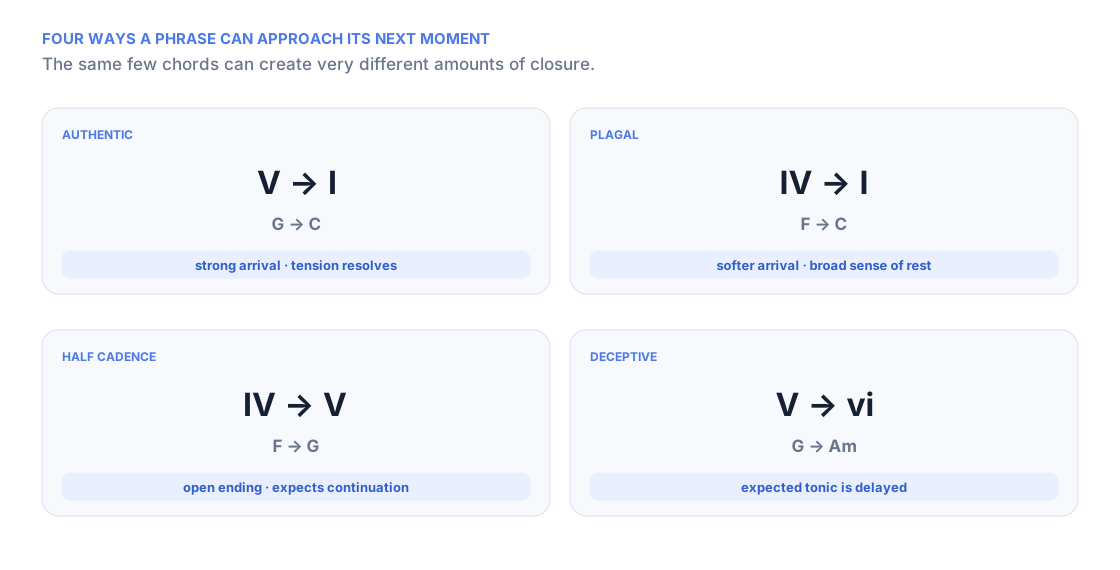
Authentic cadence: V to I
The movement:
V → I
is the basis of an authentic cadence.
In C major:
G → C
or, with seventh chords:
G7 → C
The dominant chord, V, creates tension that points strongly toward the tonic, I.
This is one of the strongest conventional ways to make a major-key phrase feel complete.
For example:
F → G → C
can be read as:
IV → V → I
The IV chord moves away from home, V increases the tension, and I resolves it.
Classical theory divides authentic cadences into more specific types depending on inversion, melody note and voicing. Those distinctions can be useful later, but for writing chord progressions the important idea is simply the strong dominant-to-tonic pull of V to I.
Minor keys often strengthen V before resolving to i
Natural minor gives us a minor chord on degree 5.
In A natural minor:
Em → Am
or:
v → i
That can work perfectly well, but it produces a softer resolution than a major dominant.
A very common alternative is to raise the 7th scale degree temporarily, giving us a major V chord:
E → Am
or:
V → i
Add the seventh and the pull becomes even clearer:
E7 → Am
This is one of the main reasons harmonic minor is so useful. Raising the 7th creates a leading tone just below the tonic and turns the minor v into a major V.
In A minor:
- natural minor contains G;
- harmonic minor raises that note to G#;
- E–G#–B forms E major;
- E or E7 then resolves strongly to Am.
So a progression does not always stay inside one fixed version of the minor scale from beginning to end. Minor-key harmony often mixes natural-minor and harmonic-minor behavior when a stronger cadence is useful.
Plagal cadence: IV to I
Another familiar arrival is:
IV → I
In C major:
F → C
This is usually called a plagal cadence.
Compared with V → I, it generally creates less dominant tension. The movement can feel broad, warm or settled without the same sense of being pulled toward the tonic.
In minor, a similar movement can be:
iv → i
For example in A minor:
Dm → Am
Plagal movement appears in many musical contexts, but it does not always function as a dramatic phrase ending. It can simply be part of a loop or a smooth return toward the tonic.
That is an important theme throughout these guides: the same two chords can have different effects depending on timing and context.
Half cadence: ending on V
A cadence does not have to resolve.
A phrase that ends on V creates what is commonly called a half cadence.
For example in C major:
C → F → G
or:
I → IV → V
Instead of returning home, the phrase stops on the dominant.
That often feels unfinished.
Your ear may expect something to follow, which makes this useful when one phrase should lead into another.
You can think of it as ending a sentence with a comma rather than a full stop.
In an arrangement, a half-cadence-like ending can be useful before:
- the next phrase;
- a chorus;
- a drop;
- a turnaround;
- a repeated section that supplies the eventual resolution.
Deceptive cadence: the expected resolution goes somewhere else
Once the ear expects:
V → I
we can create surprise by sending V somewhere else.
A classic example in a major key is:
V → vi
In C major:
G → Am
The G chord creates a strong expectation of C, but Am arrives instead.
This is often called a deceptive cadence.
The tension is not simply abandoned. The new chord shares notes with the expected tonic and can sound convincing while delaying the full resolution.
In minor keys, a common deceptive movement is:
V → ♭VI
For example in A minor:
E → F
Instead of E resolving to Am, the harmony moves to F major.
This can extend a phrase, create an emotional lift or delay the return to the tonic.
The word deceptive sounds dramatic, but in practice the technique can be very subtle. The listener does not need to consciously think “that should have gone to I” for the delayed resolution to have an effect.
Cadences do not need to happen only at the end of a song
It is easy to hear the word cadence and imagine the final two chords of a piece of classical music.
In modern songwriting, it is more useful to think at the phrase level.
A four- or eight-bar phrase might end with a strong resolution.
The next phrase may then start again immediately.
A verse might deliberately remain open so the chorus feels more conclusive.
A breakdown might hold dominant tension for several bars before the next section arrives.
So when we say a progression has an “open ending” or a “resolved ending”, we are talking about how its last harmonic event behaves in context, not whether playback literally stops.
In a loop, the real cadence may cross the loop boundary
Loop-based music introduces an important twist.
Suppose a four-chord progression is:
C → Am → F → G
If it loops, the actual sequence is:
C → Am → F → G → C → Am → F → G ...
The final G does not resolve inside the four displayed chords.
Its resolution happens when the loop restarts on C:
V → I
So the boundary between the last chord and the first chord is part of the harmony.
This matters especially in electronic music, where progressions are often designed to repeat continuously.
A progression can therefore look “unfinished” when written once and still make perfect musical sense as a loop.
House and trance often use resolution differently
Genre changes how obvious a cadence needs to be.
A house track may repeat a compact progression for a long time without needing a strong V → I cadence on every cycle. Groove, bass, repetition and voicing can create enough continuity by themselves.
Trance often uses strong emotional minor-key motion, but a progression may remain open so that the loop keeps pulling forward. A major V → i resolution can be powerful when used, but using it constantly can make every phrase feel too final.
Jazz can make cadential motion more explicit through seventh chords, extensions and voice leading.
Blues often treats dominant-seventh harmony differently again: even the tonic chord may be a dominant seventh, so the classical idea of “stable tonic versus dominant tension” does not map perfectly onto every bar.
The useful question is therefore not:
Which cadence is correct for this genre?
A better question is:
How resolved or unresolved should this moment feel?
Strong and weak resolution are both useful
A strong cadence can help:
- finish a section;
- make a chorus arrival feel satisfying;
- mark the end of a longer harmonic phrase;
- release tension that has been building.
A weaker or open ending can help:
- keep a loop moving;
- lead into another phrase;
- create anticipation;
- avoid making every four bars feel finished;
- leave space for melody or arrangement to provide the sense of direction.
Neither is inherently better.
If every phrase resolves strongly, the music can become predictable.
If nothing ever resolves, the music can feel directionless.
Much of harmonic writing is about controlling that balance.
A practical way to hear cadences
Instead of memorizing names first, try listening to the effect.
In C major, compare:
Strong arrival
G → C
V → I
Softer arrival
F → C
IV → I
Open ending
F → G
IV → V
Delayed expectation
G → Am
V → vi
Play each pair several times.
Then listen to how differently the second chord feels in each case.
That experience is more useful than treating cadence names as a list to memorize.
The names simply give us a convenient way to talk about harmonic behaviors that your ear can already learn to recognize.