Music Theory Basics: Notes, Scales, Chords and Progressions
Start here if terms like key, scale or chord are still new. This guide builds the basic vocabulary you need to understand the Studio without assuming previous music-theory knowledge.
You do not need to know a lot of music theory to use Chord Progression Studio.
But a few words appear everywhere in music: note, scale, key, chord and chord progression. If those words are still a little vague, this page is the best place to start.
The goal is not to turn this into a complete music-theory course. It is simply to build a clear mental picture of the pieces we will use throughout the rest of Learn.
Notes: the basic building blocks
A note represents a musical pitch.
For the harmony used in Chord Progression Studio, the note names are based on:
C D E F G A B
After B, the names repeat:
C D E F G A B C D E ...
The second C is higher than the first C. The distance from one C to the next C is called an octave.
You can see this repeating pattern very clearly on a piano keyboard. The same note names come back again and again, but at higher or lower pitches.
When people say a melody is made of notes, or a chord contains several notes, these are the building blocks they mean.
Sharps and flats
There are more pitches than the seven letter names above.
Between many of those notes we also have sharps and flats.
A sharp raises a note by one small step:
C → C#
A flat lowers a note by one small step:
B → Bb
On a piano, the black key between C and D can be called C# or Db. For now, it is enough to know that different names can sometimes refer to the same sounding piano key.
Which name is most useful depends on the musical context. We will not need to solve that problem yet.
Half steps and whole steps
The smallest movement from one piano key to the next is called a half step or semitone.
For example:
C → C#
is one half step.
Two half steps make a whole step:
C → C# → D
You do not need to memorize interval theory at this point. The important idea is simply that the distances between notes are not random. Those distances are part of what gives scales and chords their structure.
What is a scale?
A scale is an ordered set of notes built from a particular pattern of distances.
A very simple example is the C major scale:
C D E F G A B C
If you play those notes from the first C to the next C, you hear the familiar sound of a major scale.
A scale gives us a useful musical palette. It tells us which notes naturally belong to that particular scale, and those notes can then be used to build melodies and chords.
That does not mean a piece of music is forbidden from using any other note. Real music often steps outside its basic scale for color, tension or movement.
For now, think of a scale as a starting palette rather than a set of rules.
What is a key?
A key tells us where the music feels like home.
If a piece is in C major, C normally feels like the central note: the place where the music can come to rest.
The C major scale is closely connected to that key, but key and scale are not exactly the same idea.
A scale describes a collection and order of notes.
A key describes the tonal center and the musical relationships around that center.
That distinction becomes more useful later. As a beginner, the important question is simply:
Which note feels like home?
In Chord Progression Studio, that is what the Key choice helps establish.
What is a chord?
A chord is a group of notes heard together.
For example:
C E G
played together form a C major chord.
C is the chord’s root: the note that gives the chord its name.
You do not need to know yet why E and G are the other notes, or how every type of chord is constructed. What matters here is the basic idea:
- one note gives you a pitch;
- several notes together can form a chord.
Different combinations of notes produce different chords, and those chords can feel stable, bright, dark, tense, open or many things in between.
What is a chord progression?
A chord progression is what happens when we place chords one after another over time.
For example:
C → Am → F → G
is a four-chord progression.
Each chord has its own sound, but the sequence also creates a larger sense of movement. One chord may feel settled, another may move the music somewhere else, and another may make you expect what comes next.
That movement is one of the reasons chord progressions matter so much in songwriting and electronic music.
A progression can be very short and repetitive or much longer and more varied. Neither is automatically better. A simple loop can be exactly what a track needs.
At this stage, you do not need to understand why one progression works differently from another. The next chapters will gradually build that picture.
How these ideas connect
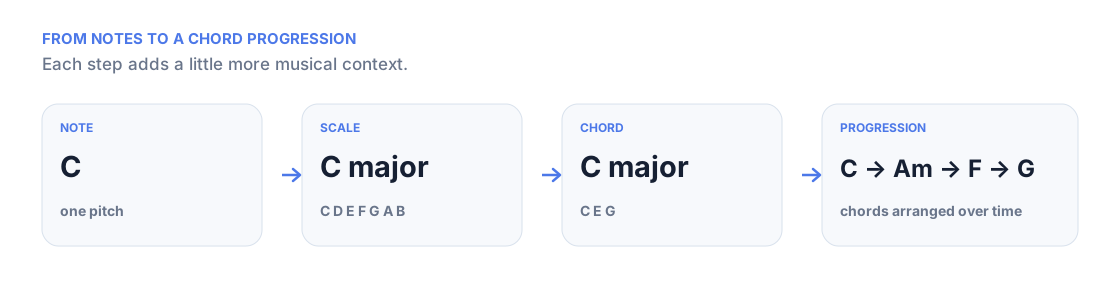
We can now put the pieces together:
Notes are individual pitches.
Scales organize a set of notes into a musical palette.
A key gives the music a tonal home.
Chords combine notes so they sound together.
A chord progression places chords in sequence to create harmonic movement.
Those ideas overlap, but they are not interchangeable. A progression is made of chords; chords are made of notes; scales and keys help define the musical context in which those notes and chords are heard.
That is enough theory to understand the basic choices in the Studio.
How this maps to Chord Progression Studio
When you open Chord Progression Studio, the controls use the same vocabulary:
Key chooses the tonal home. If you choose A, the generated progression is organized around A as its center.
Scale chooses the musical palette and harmonic character we start from. Major, Minor and the other available scales each change which kinds of harmonic relationships are natural or characteristic.
Number of chords controls the basic length of the generated progression. A short progression is not necessarily simpler musically, but it contains fewer chord events before the pattern repeats or ends.
Style influences which progression patterns and musical treatments are preferred for the selected genre or context.
You can then Play the result to hear the progression and export it as MIDI if you want to continue working with it in your DAW.
You do not need to understand all of the theory behind those choices before experimenting. In fact, hearing the difference between settings is one of the easiest ways to learn.
The rest of this Learn section takes each idea further, starting with scales and modes.